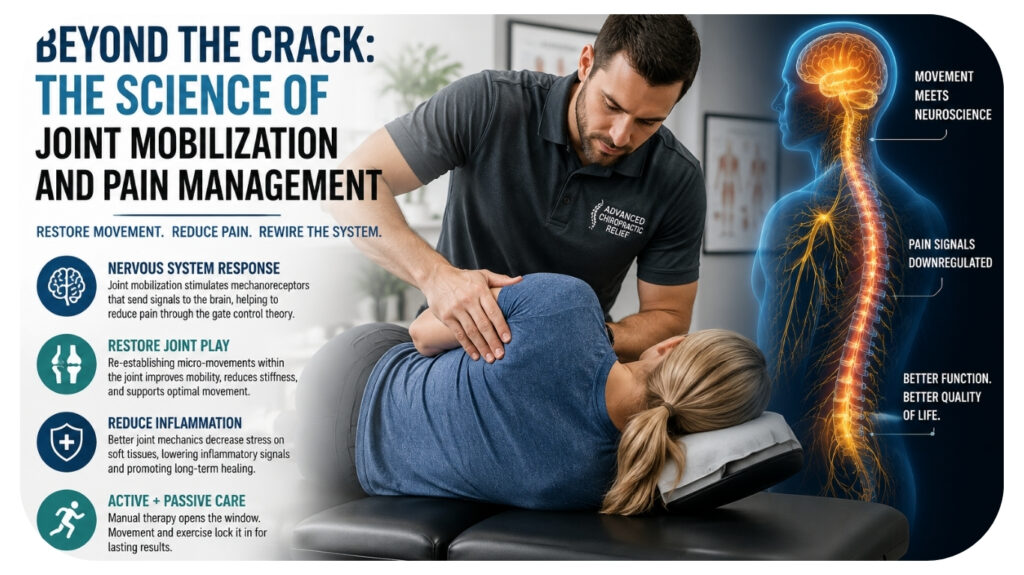
Beyond the Crack: The Science of Joint Mobilization and Pain Management
Most individuals believe that the “pop” from a chiropractic adjustment is what creates the success. Not the case. The sound you hear is cavitation, the sudden decrease in pressure within the joint capsule, which causes the gases that are dissolved in the synovial fluid to come together and pop as a bubble. It is a physiological result. Not a therapeutic one. You can be adjusted and not hear a sound and the outcome can be just as successful. When you learn what is taking place with joint mobilization, it changes your entire perspective on chiropractic care.
What Happens in the Nervous System During Mobilization
When a joint is mobilized, the first structures that respond aren’t the bones or the cartilage, they’re the mechanoreceptors, sensory nerve endings embedded in the joint capsule and surrounding tissue that detect pressure and movement. They send those signals up the spinal cord to the brain and effectively block pain signals in their path.
This is gate control theory in action. Non-painful input (gentle or high-velocity movement of a joint) closes the gate to painful input. The nociceptors (nerve endings that signal pain) get downregulated, or turned down. The brain receives less distress signaling. The patient reports less pain. This is not the placebo effect. This is a real, measurable, neurological response.
The happy result is an increase in that pain threshold that can last well beyond the appointment itself. Repeated mobilization over time can in fact contribute to neuroplasticity, changes in how the brain maps and processes pain signals from a given region of the body.
From Relief to Recalibration
A single adjustment can create a “window of opportunity,” where pain decreases, movement increases, and the nervous system is more responsive. What occurs in that window decides if the change is long-lasting.
This is when the passive aspects of care intersect with the active. The mobilization or adjustment received by the patient establishes the conditions. What the patient partakes in following the treatment, whether it is movement, corrective exercises, balance training, decides whether the conditions hold. The adjustment opens the window. The ensuing activities lock it in.
Visiting Advanced Chiropractic Relief should not be about seeking temporary relief for each episode. It is a methodical process of altering the interaction between the musculoskeletal system and the nervous system, recognizing the mechanical dysfunctions that leave one predisposed to further injury, and systematically uprooting them via manual therapy and movement work.
This matters because most people stop active care as soon as an acute episode passes and minor relief has been felt. The relief itself is genuine, but it is the cumulative neurological and mechanical changes taking place across the treatment schedule that deliver long-lasting results.
Joint Play and Why it Matters More Than Most People Realize
Joint play is a manual therapy term used to define the small micro-movements that happen inside a joint independent of voluntary motion. These movements cannot be performed voluntarily either. They are passive, and they are necessary. They get lost when joint immobilization happens, and convert voluntary movement into rigid and painful.
When joint play is lost, such as through injury, poor posture, inactivity, or repetition, its loss is detected by the nervous system, causing muscles to contract and fascia to stiffen to protect against what it perceives as a new, limited range that must be protected. This protective stiffening and tightening lead to even more joint play loss and a cascade of symptoms that moves throughout the kinetic chain.
Re-establishing joint play is not about cracking something back into place. It’s about restoring the movements that allow optimal voluntary motion. Spinal manipulative therapy (SMT) is one possible approach to re-gain this lost joint play. High-velocity, low-amplitude thrusts are one way. Less aggressive oscillatory mobilization techniques are also part of the arsenal. The choice depends on the patient’s specific condition, tolerance, but also preference and goals.
The Inflammation Connection
Pain and inflammation are related, but their connection is not always straightforward. When joints are restricted, it leads to increased mechanical stress on the soft tissue surrounding them. This chronic stress causes the release of pro-inflammatory cytokines, which are chemical messengers that promote an inflammatory response even when there is no acute injury present.
By improving the mechanics of the joint, that mechanical stress is reduced. With less stress on the soft tissue, there is less need for an inflammatory response. This is why many patients with chronic musculoskeletal complaints note systemic changes (e.g., better sleep, less general aching) after having their joint function restored. The local change has more global ramifications.
Spinal manipulation and mobilization have been linked to clinically significant improvements in pain and function, with the American College of Physicians now recommending these non-pharmacological treatments as first-line therapy for both acute and chronic low back pain.
What Evidence-Based Chiropractic Actually Looks Like
Chiropractic care is often seen in the media, and pop culture, as a series of dramatic back cracks. Unfortunately, for some, this may be what their experience of complementary care looked like.
A thorough assessment may often reveal limited or excessive joint mobility, poor posture, altered gait, poor quality soft tissue, and altered neurological function. All of these components contribute to the clinical picture of pain and dysfunction. Treatment may incorporate manual therapy, dry needling, exercise/education/rehabilitation. The modality is a direct mirror to the assessment results.
Pain is easy to measure. The more difficult to measure but often more significant functional deficits are restricted joint play, impaired proprioception, compensatory and impaired muscle patterns, and continued inflammatory load.
The easy fix is treating the symptom. The best solution is to treat the cause. The former is fast, the latter takes time. Which would you prefer?


Most Inside Editorial Team
MostInside is an independent publication focused on growth across lifestyle, business, finance, sports, and digital authority, prioritizing long term value and enduring credibility.