

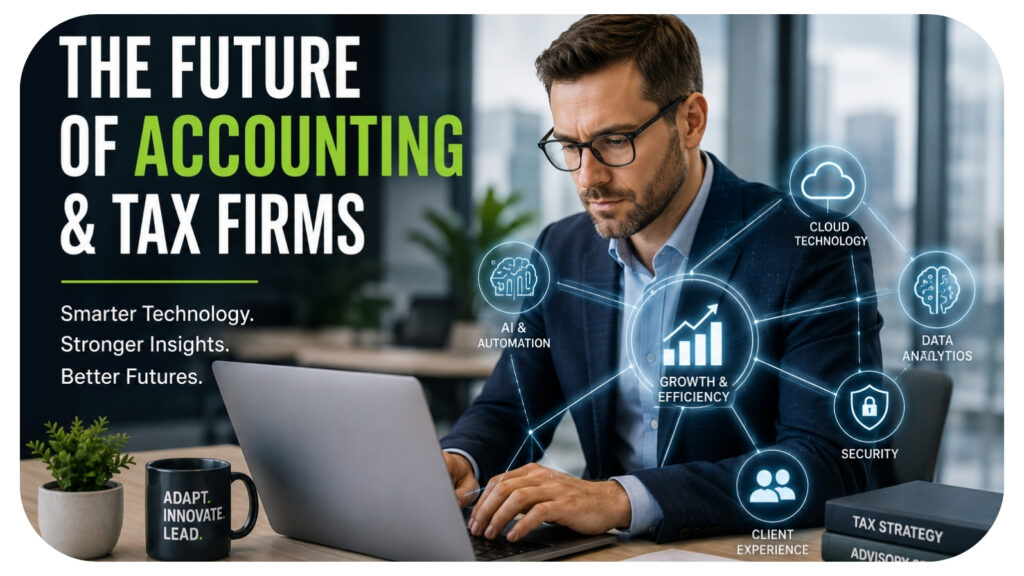
You might be feeling a quiet pressure building around you. Clients expect faster answers, tax rules keep changing, software vendors knock on your door with “must have” tools, and every conference talk seems to warn that traditional firms are running out of road. As you consider options like outsourced bookkeeping in Darien, you are doing real work for real people, yet it can feel as if the ground is shifting under your feet.
At the same time, you probably sense that there is opportunity here. Cloud tools, automation, and data analytics promise less drudgery and more meaningful advisory work. Because of this tension, you might wonder whether your firm will be left behind or whether you can turn this moment into a turning point.
The short version is this. The future of accounting and tax firms will belong to those who blend human judgment with digital systems, who stop fighting automation and start using it to deepen client relationships. The work will change, the skills will change, and the business model will change. Your value will move from “doing the numbers” to helping people understand what those numbers mean and what to do next.
Is the traditional accounting and tax firm model still safe?
For many practitioners, the old model used to be predictable. Busy season, long hours, compliance work, repeat. Technology was helpful, but not central. Today, tax administrations are rolling out end to end digital platforms and real time reporting. For example, OECD research on tax administration digitalisation and digital transformation initiatives shows just how aggressively governments are moving to automate processes that firms once handled manually.
So where does that leave you when governments and software begin to automate tasks that used to be billable work for your firm
This is where the anxiety kicks in. If compliance becomes more automated, will clients still need you Will fees drop Will younger staff even want to join a profession that seems to be in flux These questions are not just financial. They are also emotional. Identity, purpose, and career paths are all in play.
The honest answer is that some work will disappear or shrink. Data entry, basic reconciliations, and routine returns are already being handled by software in many firms. But another truth sits beside that one. As systems produce more data, clients are flooded with numbers and alerts and they still need someone they trust to interpret all of it and to stand beside them when decisions have consequences.
The future of accounting and tax services will not be about fighting technology. It will be about deciding which parts of your work should be handled by machines and which parts must stay human.
What new pressures and possibilities are shaping your future role
Think about a small business client who connects their bank feeds, invoicing, and payroll to a cloud platform. They can see their cash position at a glance. Tax estimates appear automatically. On the surface, it might look as if they need you less. Yet when their revenue drops, when they consider hiring, or when they face a tax audit, they rarely want to face those choices alone.
This is the opening for a more advisory driven firm. The International Federation of Accountants has highlighted three major changes reshaping the accounting profession, including digital skills, broader business insight, and a shift toward forward looking advice. That means the profession is not shrinking so much as evolving.
Yet the path is not painless. You may feel caught in the middle. Your current revenue still depends on compliance work, but you are being told to “move to advisory” without clear guidance on how to do that while keeping the lights on. Staff need training. Systems need investment. Change carries risk.
A useful way to think about this is to separate the problem into three parts. First, what work is being automated and how quickly. Second, what your clients actually value and fear. Third, how you can use digital tools to deliver that value more consistently without burning yourself out.
How should you compare your options in a digital accounting future
To make this more concrete, it helps to compare different strategic choices that firms are making in response to the future of accounting and tax firms in a digital environment.
| Approach | What it looks like in practice | Main risks | Main benefits |
|---|---|---|---|
| Stay traditional and resist change | Minimal tech adoption. Manual processes. Focus on yearly compliance. Limited advisory. | Fee pressure as automation spreads. Difficulty attracting younger staff. Clients drift to digital first providers. | Short term comfort. Known processes. No major upfront tech investment. |
| Adopt tools but keep the same services | Use cloud software and automation to do the same compliance work faster. | Efficiency gains may be passed on as lower fees. Hard to stand out if everyone uses similar tools. | Lower internal costs. Less repetitive work. More capacity in busy periods. |
| Rebuild as advisory led, digitally enabled | Automate routine tasks. Offer regular check ins, forecasting, and decision support. Package services around outcomes, not hours. | Requires new skills and mindset. Short term disruption. Need to educate clients on new value. | Stronger client loyalty. Higher value work. Better use of data. More attractive career paths for staff. |
You do not have to jump from one column to another overnight. Many firms move gradually, starting with internal automation, then shifting their conversations with clients, then adjusting pricing and service bundles once the new way of working feels natural.
What practical steps can you take right now
You might be wondering what you can actually do this quarter, not in some distant strategic plan. Here are three grounded steps to move toward a more resilient model of digital accounting and tax services.
1. Map your current work into “automate” and “advise”
Take one typical month and list the main tasks your firm performs. Mark each task as “routine” or “judgment heavy.” Routine tasks include data entry, standard reconciliations, simple returns, and report generation. Judgment heavy tasks include interpreting results, planning, structuring deals, or guiding clients through audits.
Then ask two questions. Which routine tasks can be automated with tools you already own but are underusing. Which judgment heavy tasks could become defined services, such as quarterly strategy sessions or scenario planning. This simple mapping exercise helps you see where to invest in software and where to invest in people.
2. Choose one client segment and deepen the relationship
Instead of trying to transform everything, pick one clear client segment. For example, owner managed businesses in a certain revenue range. Schedule short conversations with a few of them and ask what they worry about at night, what decisions are hardest, and which numbers they actually look at.
Use what you hear to reshape how you show up. Maybe you offer a monthly “cash clarity” call. Maybe you create a simple dashboard that highlights three metrics that matter to them. The goal is to move your service from “filing and fixing” to “guiding and preventing.” This is the heart of the future of accounting work.
3. Invest in one meaningful digital skill for your team
Change can feel vague until you turn it into learning. Pick one digital capability that will clearly support your future direction. It might be data visualization, workflow automation, or collaborative cloud tools. Assign a small group to explore it, test it on one internal process or one client, and then share what they learned with the rest of the firm.
This does more than improve efficiency. It signals to your team that growth is part of the culture. It also builds confidence that you can adapt, which matters just as much as the specific software you choose.
How can you move forward with confidence
The future of accounting and tax is not a story of humans versus machines. It is a story of routine work shifting toward systems, while relational and strategic work shifts toward you. Clients will still need someone who can listen, understand their goals, and translate data into decisions that feel right for their business and their life.
You do not need to transform everything at once. You do need to start. Begin by seeing your own situation clearly, by acknowledging both your concerns and your strengths. Then take one step to automate, one step to deepen client conversations, and one step to build new skills inside your firm.
Over time, those small moves can turn confusion into a clearer path, and that path can carry you from a reactive practice to a firm that is ready for whatever the digital world brings next.
Recommended: 3 Signs It’s Time To Find A New CPA For Your Business




Leave a Reply