
Why Investing in Quality Fishing Gear Makes a Difference on the Water
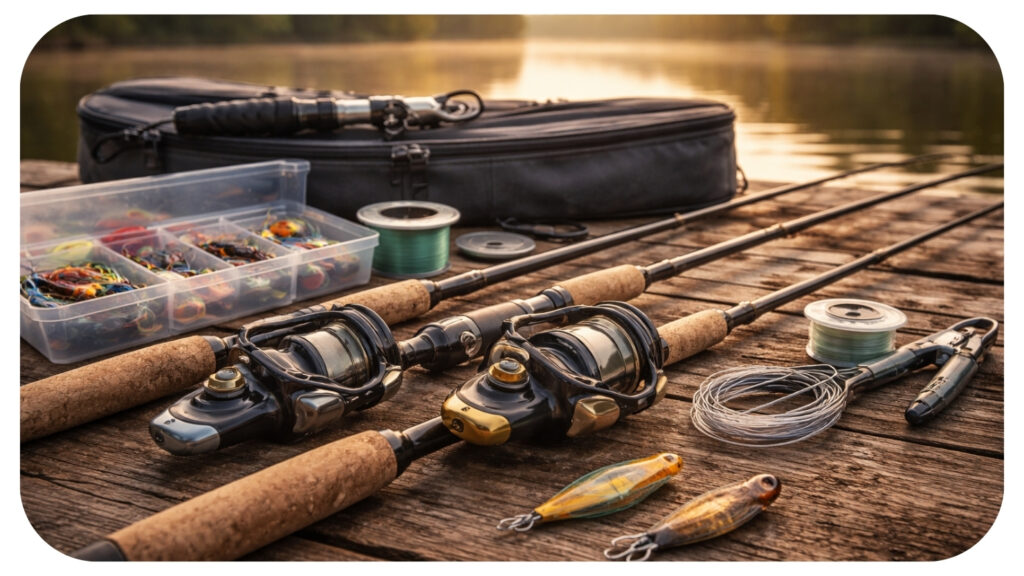
Many fishermen often share a memory of a fish they failed to reel in. What they might not reflect on is if the fish was simply too strong for them, or if their gear was not good enough. Fishing gear is more than just equipment – it reflects the level of commitment you have to your fishing experience.
Removing the mechanical variables
Premium gear doesn’t catch more fish. But it does put more of your hooks in their mouths, which can improve the amount you manage to bring home at the end of a day.
Where cheap gear actually costs more
Unfortunately, the weakest point on most budget rods is the butt section, which coincidentally (or not!) is normally subjected to the highest loads. When any part of a rod fails under load, it’s easy for the rest to follow suit. Cheaper blanks tend to run too much resin (the matrix which binds together the carbon or glass fibers), meaning equipment is heavier than it needs to be for the strength it offers, and far less reliable under push.
The rod butt, guide wraps and inserts, reel seat, handle, tip glue should all remain almost invisible to you when you fish. They just do their job. It’s the same with the blank. Beyond dampening casts, vibrations, and shocks (which poorer-quality blanks tend not to do well), a rod’s main task is to ease smoothly from detection (taking the bait) to resistance (hook-set) to control (playing the fish) back to resistance (urging it towards the net) to zero (scooping it up). These final split seconds are when many fish are lost. If the rod played a part in that loss, then it failed in its main duty.
Casting accuracy and reaching the right water
Rod taper and action are also important in ways that aren’t often talked about. Higher priced rods are designed with specific bend profiles – fast tapers for ‘whipability’ in terms of casting, long-range accuracy and so on. Fast tapers are great; they make a rod feel lighter and crisper and they help you cast further. While they might not feel as forgiving as a more moderate-tapered rod their fighting curve can be completely different, being fast to back off and allowing the blank to play the fish which is also why there’s less chance of hook-pulls or breakages with fast-action rods.
Protecting what you’ve invested in
The best carbon blank in the world is a fragile thing, or rather can become so during transit in a way that’s specific to high-spec fishing gear. The slightest ‘tap’ or bump against a hard edge, doses of low but persistent pressure or shock, and blanks that might appear unmarked and undamaged will nevertheless have potential loads reduced to one-trip-from-the-end levels… and fail just as you finally locate and hook that fish of a lifetime.
Unlike practically any other object you routinely pack into a vehicle and then pack load-borne over considerable distance, blanks have to be virtually perfect (the perfect blank, remember, not just any old bent tree or bit of steel pipe) and this virtual perfection is unlikely to survive poor treatment. Hairline fractures are the arch-enemy of carbon fibre. They can remain utterly undetectable until the single moment the rod blank is called on to perform, at which point they announce their presence by complete and catastrophic failure in the most stressful and hazardous situation possible.
For the peerless carbon-fiber rod blank, then, what you pack and carry it in might just be even more important than everything else you’ve invested in. Investing in premium rod protection is not an add-on: it’s the final component of the high-performance piece of kit. A good, tailored and padded transport solution keeps the blank from developing bruising that no amount of care in use can undo.
Ergonomics and session length
Extended sessions also create fatigue. Cork and EVA handles aren’t interchangeable aesthetic choices. Cork offers better grip in wet conditions and doesn’t transfer cold as readily. Handle design and reel seat fit determine how your hand and wrist sit over hours of fishing – and accumulated fatigue affects striking speed and line control in ways that are hard to see until you’re comparing sessions back to back.
Quality gear is built around the angler as well as the fish. That’s not something you notice immediately. It shows up at hour twelve.
The best fishing gear won’t catch fish for you. But it removes the reasons you’d lose one – the drag hesitation, the fractured blank, the guide failure at the wrong moment. That’s what the investment actually buys: sessions where the only variable left is skill, reading water, and a little luck.

Recommended For You
How to Do Social Work?

Most Inside Editorial Team
MostInside is an independent publication focused on growth across lifestyle, business, finance, sports, and digital authority, prioritizing long term value and enduring credibility.