

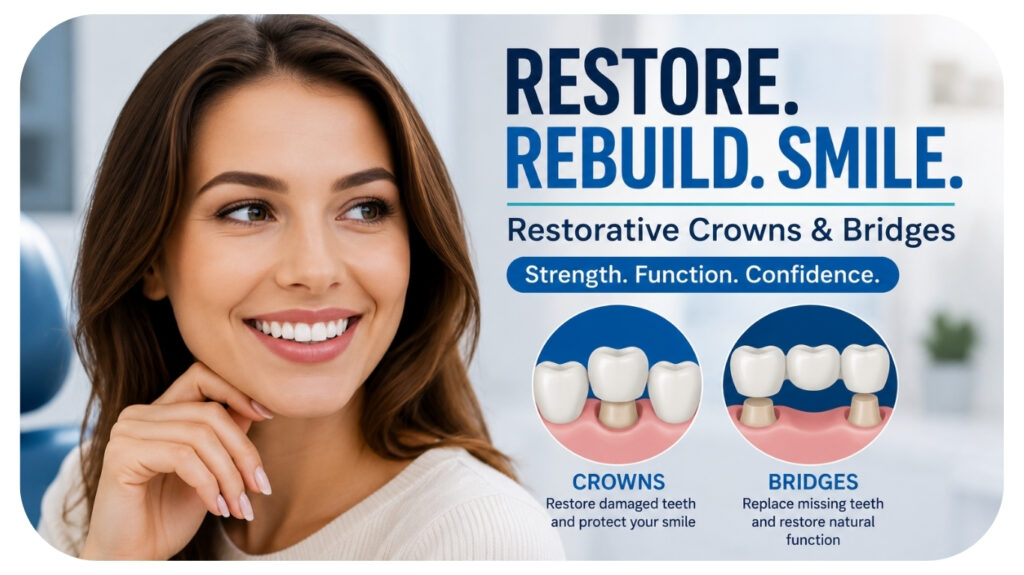
You might be here because chewing has started to feel awkward, a tooth has cracked one time too many, or you are tired of hiding your smile in photos. Maybe your Woburn family dentist mentioned crowns or bridges and you nodded along, but inside you were thinking, “What does this actually mean for me, my wallet, and my day-to-day life?”end
That worry makes sense. Teeth are personal. They affect how you eat, how you speak, and how you feel about yourself in a crowd. When something goes wrong, it is not just a “dental issue.” It touches your confidence and your comfort, and it can feel overwhelming to sort through all the options.
Here is the short version. Restorative crowns and bridges are tried-and-true treatments in general, cosmetic, and restorative dentistry. They can protect weakened teeth, replace missing ones, and bring back a natural-looking smile. They also help you avoid bigger, more expensive problems later. The rest of this page simply walks you through what that actually looks like in real life, so you can decide with a clear head, not from a place of panic.
What exactly are crowns and bridges, and why do they matter so much?
Before talking about advantages, it helps to be clear on what these treatments are. A crown is a custom-made cap that covers a damaged tooth. It restores the tooth’s shape, strength, and appearance. A bridge replaces one or more missing teeth by anchoring artificial teeth to the natural teeth on either side. Both are considered standard parts of restorative dental treatment and are recommended by major medical and dental organizations.
If you want a simple medical description, you can find one in this MedlinePlus overview of dental crowns. It explains how crowns are used when fillings are no longer enough, such as after a root canal or a large fracture.
So, where does that leave you? If you are dealing with pain, difficulty chewing, or a gap where a tooth used to be, you are probably weighing three things at once. Your comfort, your appearance, and your budget. This is where the three key advantages of crowns and bridges start to matter.
Advantage 1: Protecting and saving teeth instead of losing them
The first advantage is protection. When a tooth is badly cracked, heavily filled, or weakened by decay, it becomes fragile. Everyday chewing can cause more fractures. In the worst case, the tooth can break beyond repair, which often leads to extraction.
This is the “quiet” risk many people do not see. A tooth may not hurt very much yet, so it is tempting to ignore it. Then one day you bite into something a little too hard, and suddenly you are looking at an emergency visit, a lost tooth, and a much bigger bill.
A well-fitted crown acts like armor. It covers the entire visible part of the tooth and helps distribute bite forces more evenly. That reduces the chance of further cracking and can extend the life of the tooth by many years. The University of Illinois Chicago explains how crowns restore both function and strength in its guide to crowns and bridges in family dentistry.
In practical terms, choosing a crown is often choosing to keep your natural tooth instead of moving straight to extraction and implants or dentures later. That is a big long-term win for both your mouth and your budget.
Advantage 2: Restoring your bite, speech, and confidence after tooth loss
The second advantage is what a bridge can do for your daily life. When a tooth is missing, the gap is not just a cosmetic concern. Neighboring teeth can drift into the space. Your bite can change. Food can pack into the gap and irritate the gums. Chewing may shift to one side of the mouth, which can strain the jaw.
Emotionally, people often start to cover their mouths when they laugh or avoid certain social situations because they feel self-conscious. That constant awareness of the gap can wear you down more than you might expect.
A bridge fills the space with a natural-looking replacement tooth that is fixed in place. You do not take it in and out like a removable denture. This can:
- Make chewing more comfortable and efficient
- Support clearer speech, especially if a front tooth was lost
- Help keep neighboring teeth from drifting and tipping
- Restore a smile that looks whole again
When people talk about the “cosmetic” benefit, they are often talking about something deeper. Being able to smile, eat, and speak without worrying about who might notice your teeth can change how you show up at work, with family, or in photos. That is not vanity. It is about feeling like yourself again.
Advantage 3: Long-term value compared with “patching things up”
The third advantage is long-term value. Dentistry can feel expensive, so it is normal to look for the least costly option in the moment. The problem is that repeated “patches” on a tooth that really needs a crown can add up, both in money and in discomfort.
For example, a large filling might crack, then need to be replaced, then crack again, and finally the tooth breaks so badly that a root canal or extraction is needed. By that point, you may have spent more on short-term fixes than on a single strong restoration from the start.
State boards and professional groups often summarize these tradeoffs in patient materials. A New Hampshire restorative dentistry fact sheet explains how crowns and bridges are used to restore function and reduce long-term risk when teeth are badly damaged or missing.
So, while a crown or bridge is a bigger upfront investment than a small filling, it usually provides better protection, more comfort, and fewer emergencies over time. That is the heart of the value question.
How do crowns and bridges compare with “doing nothing” or quick fixes?
It can help to see the tradeoffs side by side. You may be asking yourself, “What if I just wait?” or “What if I only get a small filling?” The table below offers a simple comparison.
| Option | Short-term cost | Comfort and function | Risk over the next 5 years |
|---|---|---|---|
| Do nothing about a damaged or missing tooth | Zero right now | Ongoing pain or difficulty chewing, visible gap if tooth is missing | Higher risk of fractures, shifting teeth, gum problems, and more complex treatment later |
| Repeat small or medium fillings on a weakened tooth | Lower per visit, may add up over time | May feel okay at first, but the tooth stays fragile | Rising risk of sudden breakage, possible need for root canal or extraction |
| Restorative crowns and bridges | Higher upfront cost | Improved chewing, more natural appearance, better protection | Lower risk of breakage and shifting, more stable bite, fewer emergencies when well maintained |
Every mouth is different, of course, but this gives you a sense of why many dentists recommend crowns and bridges treatment once damage reaches a certain point. It is less about “selling” something and more about avoiding a cycle of repeated problems.
Three practical steps you can take right now
So, what can you do today, even if you are not ready to schedule anything yet?
1. Get a clear diagnosis and ask “what if I wait?”
If you have not already, schedule an exam with a dentist you trust. Ask them to show you the tooth or gap on an X-ray or photo and to explain in plain language what is going on. Then ask two specific questions. “What are my options?” and “What happens if I do nothing for 6 to 12 months?” The answers will help you understand whether a crown or bridge is a strong recommendation or just one of several reasonable paths.
2. Talk openly about cost, insurance, and timing
Money is a real concern. You are not being difficult by bringing it up. Ask the office to check your insurance coverage and prepare estimates for each option. Many practices offer payment plans or can stage treatment so the most urgent work comes first. Knowing the numbers and the timing can reduce a lot of hidden stress.
3. Protect what you have while you decide
Even if you are still thinking, you can take simple steps to protect your teeth. Brush twice a day with fluoride toothpaste. Floss daily. Avoid chewing hard items like ice or pens, especially on a cracked or heavily filled tooth. If you grind at night, ask about a night guard. These habits will not replace restorative care, but they can help keep things from getting worse while you make a thoughtful choice.
Finding a path forward that feels right for you
You do not have to become an expert in dentistry to make a good decision about crowns and bridges. You just need clear information, space to ask questions, and a dental team that respects your concerns about comfort, appearance, and cost.
Remember why this matters. You are not only fixing a tooth. You are protecting your ability to eat comfortably, speak clearly, and smile without second-guessing yourself. That is worth taking seriously, and it is also very achievable.
When you are ready, reach out to a general, cosmetic, and restorative dentistry provider, bring your questions, and use what you have learned here to guide the conversation. You deserve care that protects your health and supports your confidence, not just for today, but for the years ahead.
Recommended: 3 Preventive Approaches That Improve Comfort During Dental Visits


Leave a Reply