

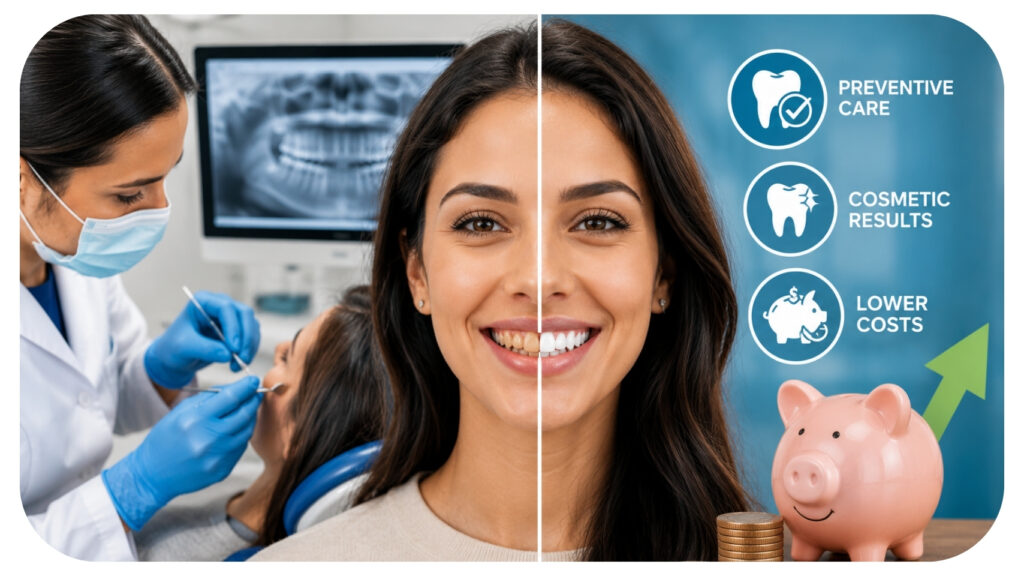
You might be looking in the mirror, noticing a chip, a darkened tooth, or a smile that just does not feel like you anymore, and wondering whether a Columbus dentist could help. At the same time, you may be worried about the cost of cosmetic work and wondering if you can justify it when regular checkups already feel like a stretch. It can feel like you are stuck choosing between the smile you want and the budget you have.end
Here is the quiet truth many people do not hear. When cosmetic care is thoughtfully combined with preventive dentistry, the overall cost over time often drops, not rises. You spend less on emergencies, less on repeat work, and you protect the cosmetic treatment you do choose so it lasts longer.
This is the heart of it. Preventive visits protect your health and your wallet. When your dentist plans cosmetic care on top of a stable, healthy foundation, you usually pay less over the years, not more.
Why does cosmetic dentistry feel so expensive in the first place?
Think about how these situations usually start. A tooth breaks on popcorn, or an old filling fractures, or you finally decide you are tired of hiding your smile in photos. You call a dentist and hear the estimate for veneers, bonding, whitening, or crowns, and your stomach drops. You might even feel a bit guilty, as if wanting nicer teeth is a luxury you are not allowed to want.
The financial stress is real. Cosmetic treatments are often not fully covered by insurance. If you have also skipped cleanings or postponed X rays, there may be hidden problems that first need to be fixed. That is when costs add up quickly. A simple whitening turns into a root canal, a crown, and gum treatment. What started as a “small upgrade” becomes a major investment.
So where does that leave you? Usually facing three uncomfortable choices. You delay care again and hope things do not get worse. You do the bare minimum and feel disappointed with the result. Or you stretch your budget and feel anxious every time the credit card bill arrives.
There is a quieter fourth path. You combine preventive and cosmetic care from the start, so every dollar you spend is working in your favor, not fighting against existing problems.
Reason 1: Preventive care protects you from costly cosmetic “do overs”
One of the most frustrating parts of cosmetic dentistry is paying for the same tooth twice. For example, imagine you invest in bonding to fix a chipped front tooth, but the bite was never fully checked, or hidden decay was not treated first. The bonding can chip, stain, or fail. Then you pay again, maybe for a crown this time, and you feel like you are starting over.
Regular exams, cleanings, and X rays help your dentist catch problems before you put a cosmetic solution on top. Studies have shown that untreated gum disease and decay significantly shorten the lifespan of restorations like crowns and fillings. Research on long term restoration survival has found that well maintained teeth and gums keep restorative work stable for many years, while poor oral hygiene and missed checkups lead to higher failure rates and replacement costs. You can see this in research on long term dental restorations and maintenance, such as findings published in studies of restoration longevity.
When you focus on preventive care first, treatments like veneers, bonding, and crowns are placed on teeth that are clean, strong, and stable. That means fewer fractures, less leakage, and fewer replacements. You are not just buying a nicer smile. You are buying time.
Reason 2: Treating small issues early keeps cosmetic work simpler and cheaper
Here is another way to look at it. Cosmetic dentistry gets expensive when it has to fix big problems. If you wait until teeth are badly worn, crooked, or broken, your dentist often has to use more complex and costly treatments to create a natural look and a healthy bite.
With consistent preventive visits, small problems are caught early. A tiny chip can be repaired with conservative bonding instead of a crown. Mild discoloration can be managed with whitening instead of multiple veneers. Early bite issues can be adjusted before they cause serious wear.
Research on preventive oriented care has shown that patients who receive regular maintenance and early interventions often have fewer major restorative needs over time. For example, studies of preventive programs have found that consistent care leads to fewer extensive fillings and extractions, and better long term tooth survival, such as data discussed in preventive dentistry outcome research.
When your mouth is kept stable, your dentist has more conservative, budget friendly cosmetic options. You get to choose from whitening, contouring, and limited bonding instead of full mouth reconstruction. The cosmetic plan becomes lighter, more targeted, and far more affordable.
Reason 3: A strong preventive routine stretches every cosmetic dollar
Even the best cosmetic work will not last if plaque, inflammation, and grinding are left unchecked. Veneers can chip, bonding can stain, and crowns can fail at the edges if the gums around them are not healthy.
Now imagine you combine cosmetic dentistry with a strong preventive plan. Regular cleanings remove stain before it soaks into bonding. Night guards protect veneers from grinding. Fluoride and hygiene coaching reduce the risk of decay forming at the edges of crowns or fillings. Suddenly your investment is not fragile. It is supported.
This is where the idea of affordable cosmetic and preventive dentistry becomes very practical. You are not paying twice. You are paying once for cosmetic work that is expected to last many years, supported by checkups and cleanings that you likely needed anyway. Over a decade, the cost per year of that improved smile can be surprisingly reasonable.
How does combined preventive and cosmetic care compare in real life?
It can help to see how this plays out in everyday situations. Consider two people with similar smiles and budgets who make different choices.
| Scenario | Short Term Choice | What Usually Happens | Typical Long Term Cost |
| Skipping preventive care, doing cosmetic only | Whitening and bonding, but no regular cleanings or exams | Hidden decay or gum issues show up later. Bonding stains or chips. More invasive work needed, like crowns or root canals. | Higher. You pay for cosmetic work, then pay again to fix failures or new disease. |
| Preventive care first, then targeted cosmetic | Routine cleanings, X rays, treat small cavities, then whitening or bonding | Cosmetic work is placed on stable teeth. Fewer surprises. Better color match and longer lasting results. | Moderate at the start, but lower over 5 to 10 years because there are fewer replacements. |
| Strong ongoing preventive plan plus cosmetic | Cleanings every 6 months, night guard if needed, hygiene coaching, plus veneers or crowns | Cosmetic work stays brighter and intact longer. Problems are caught early while still easy and cheaper to fix. | Often the lowest per year. The smile lasts, and major repairs are rare. |
This is why a thoughtful preventive and cosmetic dental care plan can feel more manageable financially. You are not reacting to problems. You are steering them.
What can you do right now to make cosmetic dentistry more affordable?
You might still be wondering what to actually do with all of this. Here are three steps that can make a real difference, even if you are starting from a place of worry or delay.
1. Be honest with your dentist about your budget and your goals
Many people feel embarrassed to talk about money, so they stay quiet and then feel trapped by treatment plans. You do not need to do that. At your next visit, share two things clearly. What you wish you could change about your smile, and what you can realistically afford each month or each year. A good family and cosmetic dentist can often phase treatment, protect the teeth that need help most, and start with small changes that fit your budget now.
2. Commit to a simple, consistent preventive routine
You do not need perfection. You need consistency. Twice daily brushing with fluoride toothpaste, daily flossing or interdental cleaners, and cleanings on the schedule your dentist recommends will protect both your natural teeth and any cosmetic work you choose. Even if cosmetic treatment feels far away today, this routine brings the cost of future care down by keeping problems smaller and more manageable.
3. Ask for a “foundation first” plan before cosmetic work
Before you agree to whitening, bonding, veneers, or crowns for appearance, ask your dentist a simple question. “What do we need to fix or stabilize first so this cosmetic work lasts as long as possible?” That conversation shifts the entire approach. You move from quick fixes to a stable plan that respects both your health and your budget. This is where a thoughtful cosmetic dentistry and preventive care strategy truly pays off.
Moving forward without feeling overwhelmed
You do not have to choose between a healthy mouth and a smile you feel proud of. When you combine preventive care with the right cosmetic steps, you protect yourself from surprise costs, painful emergencies, and repeat work that burns through your budget.
If you feel behind, you are not alone, and you are not too late. Start with one preventive appointment. Have an honest conversation about your goals. From there, you and your dentist can design a plan that respects your finances, steadies your health, and moves you closer to the smile you want, one thoughtful step at a time.
Recommended: How General Dentistry Balances Restorative And Preventive Care




Leave a Reply