

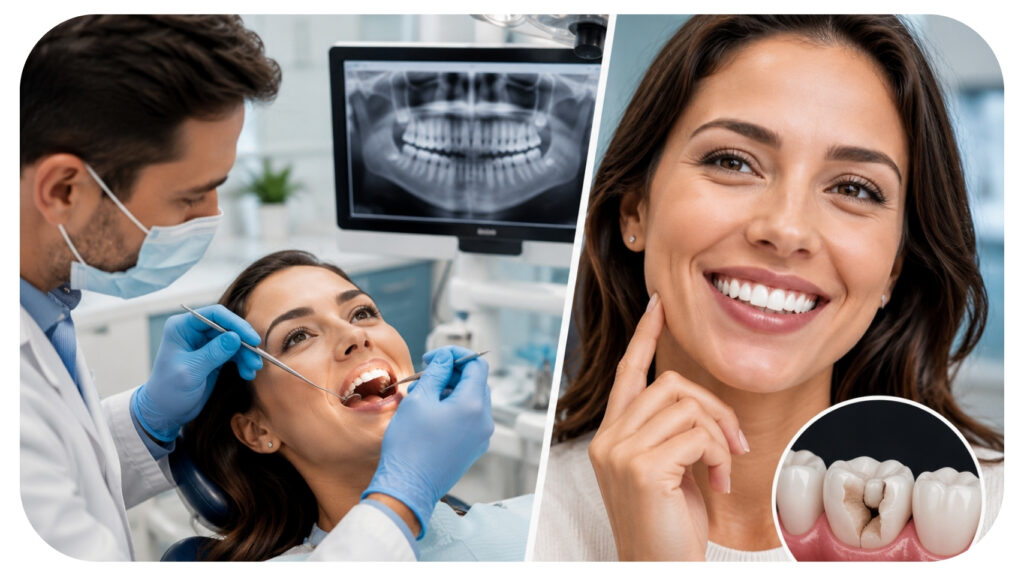
You might be feeling caught in a frustrating loop with your teeth. One visit you are told everything looks fine, then a few months later you suddenly need a filling, maybe even a crown, and you start wondering what you are missing. You brush, you do your best, yet problems still show up. It can feel unfair and a little scary, and that’s often when people start looking for a downtown Toronto dentist who can help them understand what’s really going on.
At the same time, you may have heard that a good general dentist focuses on prevention, not just fixing what breaks. So why do you still end up in the treatment chair so often. Where is the balance between stopping problems early and restoring teeth that are already damaged.
The short answer is this. General dentistry works on two tracks at the same time. It tries to prevent disease from starting, while also repairing what time, habits, and biology have already worn down. When these two pieces are coordinated, you get fewer surprises, fewer big procedures, and a clearer plan for your mouth.
So where does that leave you. It means you do not have to choose between “only cleanings” and “only fixing things.” You can use your regular visits to build a quiet, stable routine where prevention and restorative treatment support each other instead of competing for your time and money.
Why does it feel like problems appear out of nowhere?
To understand how balanced preventive and restorative dentistry works, it helps to see why teeth can seem fine one year and need work the next. Tooth decay is a process, not a moment. The enamel on your teeth is constantly losing and gaining minerals. When acid from bacteria and foods removes more minerals than your saliva and fluoride can replace, a cavity forms.
If you are curious about the science, the National Institute of Dental and Craniofacial Research explains the tooth decay process step by step. The important part for you is this. Problems often start long before you can see or feel them. By the time you notice sensitivity or pain, the decay has usually moved beyond what brushing alone can fix.
Because of this delay, you might feel blindsided. You went in expecting a routine cleaning, and suddenly you are talking about fillings or crowns. That shock is emotional. You may feel worried about the cost, embarrassed about your habits, or even guilty, as if you failed at basic self care. None of that means you are careless. It means the decay process has been building quietly in the background.
So what can general dentistry do differently. It can treat each visit as part of an ongoing story instead of a one time event. That is where the balance between preventive and restorative care really matters.
What happens when prevention and restoration are out of balance?
Think about two common extremes. On one side, everything is “watch and wait.” Small issues are monitored but not addressed. You feel relieved in the moment, but a year or two later, several teeth suddenly need bigger work. On the other side, every tiny change is treated aggressively. You feel overtreated and start to doubt recommendations.
Both patterns create stress and can drain your budget. If early decay is never strengthened with fluoride or sealants, it may quietly grow until a filling or even a root canal is needed. If every minor stain or shallow groove becomes a filling, you may lose more natural tooth structure than necessary, which can lead to more repairs later.
A thoughtful general dentistry approach aims for the middle. It uses preventive tools, like fluoride, sealants, and home care coaching, to slow or stop early disease. It also uses restorative treatments, like fillings, inlays, crowns, or sometimes implants, when the damage has gone beyond what prevention can reasonably control.
So how do you know which side you are on right now. One helpful sign is how your dentist explains your options. If you only hear “you need this” without a clear picture of what happens if you wait, or what you can do at home, you are not really being invited into that balance.
How do prevention tools actually protect you from future restorative work?
Prevention is more than “come in for a cleaning twice a year.” It is a set of tools that reduce the need for future drilling. For example, fluoride strengthens enamel so it can resist acid attacks. There is strong research supporting this. The NIDCR shares evidence on how fluoride helps prevent cavities, and this is why you see it in toothpaste, some mouth rinses, and often in-office treatments.
Sealants are another preventive tool. They are thin protective coatings applied to the chewing surfaces of back teeth. They block food and bacteria from settling into deep grooves. For children and teens, sealants can significantly cut the risk of cavities on those surfaces. For some adults with deep grooves and no decay yet, they can also be helpful.
Yet prevention is not only about products. It is also about pattern recognition. Your dentist can look at where you are getting cavities, how fast they appear, and how your gums respond, then suggest specific changes. That might mean adjusting how often you snack, changing the timing of your brushing, or using targeted tools like interdental brushes or prescription fluoride.
Why is this so important. Because dental decay is extremely common. National data show that most adults have experienced tooth decay at some point. For perspective, you can see the scale of the problem in NIDCR statistics on dental caries across different age groups. Knowing you are not alone can ease some of the shame and help you focus on what you can change next.
When is restorative treatment the right call, and what are you really choosing?
There comes a point when prevention alone is not enough. Once a cavity has broken through the enamel and into the softer dentin, the damaged area cannot rebuild itself. At that stage, restorative care is not a failure of prevention. It is the next logical step in protecting the rest of the tooth.
Here is where the balance becomes very real. A small filling today can prevent a much larger problem tomorrow. Yet you still deserve to understand the tradeoffs. You are deciding not only about today’s comfort and cost, but also about how that tooth will hold up 5 or 10 years from now.
The table below gives a simple comparison of preventive focused care and restorative focused care, so you can see how they relate rather than compete.
| Focus Area | What It Emphasizes | Short Term Experience | Long Term Impact |
| Primarily Preventive Care | Cleanings, fluoride, sealants, home care coaching, early monitoring | Lower immediate cost, fewer procedures, more education time | Fewer new cavities, smaller future restorations, more natural tooth preserved |
| Primarily Restorative Care | Fillings, crowns, root canals, extractions, implants | Higher immediate cost, more time in the chair, relief of pain or sensitivity | Stronger chewing if teeth were broken, but more maintenance and replacement over time |
Ideally your care is not “either or.” It is a thoughtful mix. You might repair a few teeth that already have clear decay, then shift quickly into stronger preventive routines so you do not repeat the same cycle on neighboring teeth.
What can you do right now to create better balance in your own mouth?
You do not need to overhaul everything at once. A few focused steps can shift your care toward a calmer, more predictable pattern.
1. Ask your dentist to map your risk, not just your current cavities
Instead of only asking “Do I have any cavities,” ask “Where am I most at risk for future problems, and what can we do to lower that risk.” This invites a deeper conversation about your diet, saliva, medications, and brushing habits. It also helps your dentist explain why certain teeth are being “watched” and what you can do at home to protect them.
2. Clarify when prevention stops and restoration becomes necessary
If your dentist recommends a filling or crown, ask “What would happen if we tried only preventive steps for a while, and how would we monitor that safely.” Sometimes there is room to try intensive prevention first, especially with very early decay. Other times, waiting would risk a crack or infection. Having your dentist walk you through that line helps you feel you are choosing, not just complying.
3. Build a simple daily routine that matches your actual life
Many people carry guilt about not flossing or missing a nighttime brushing. Instead of aiming for a perfect routine that you cannot keep, work with your dentist or hygienist to design something realistic. That might be brushing thoroughly twice a day with fluoride toothpaste, using a small interdental brush where you always get food stuck, and using a fluoride rinse at night if you are at higher risk. Consistency matters more than perfection.
Finding calm in the balance between prevention and repair
Living with dental worries is exhausting. You might feel every new appointment will bring another surprise, another bill, or another lecture about what you “should” have done. It does not have to stay that way.
When general dental care weaves prevention and restoration together, your visits start to feel more like maintenance and less like crisis management. You understand why certain treatments are recommended. You know what you can do between visits to protect your teeth. Most of all, you feel like you are working with your dentist as a partner, not sitting in the dark waiting for news.
You deserve that sense of control and calm. Your next step can be as simple as bringing one new question to your upcoming appointment. Ask how you and your dentist can create a plan that protects your natural teeth as long as possible, while handling any current problems in a measured, thoughtful way. That small conversation can be the start of a much more balanced future for your smile.
Recommended: Why Preventive Dentistry Strengthens Outcomes For Smile Transformations




Leave a Reply