

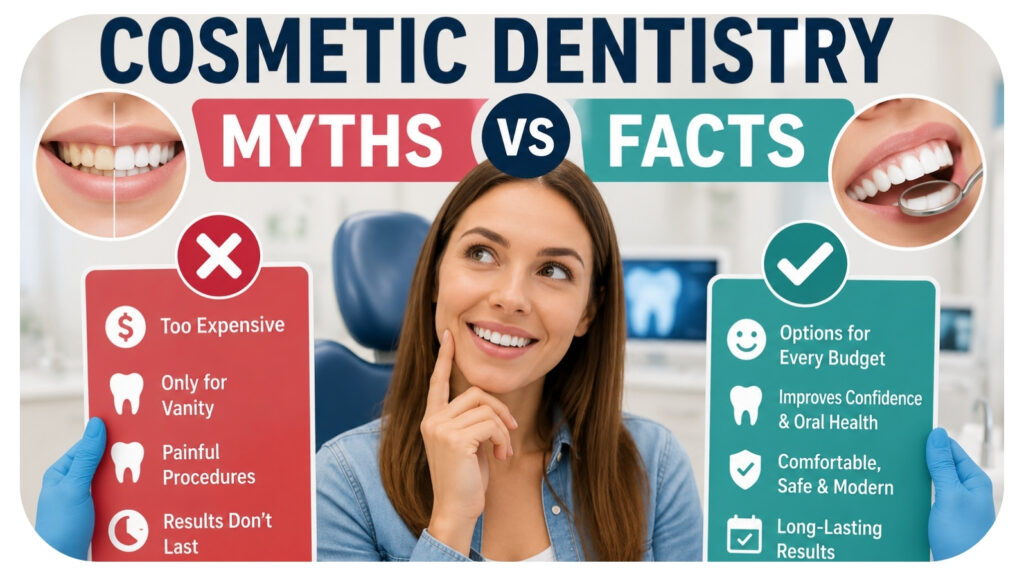
You might be feeling a mix of curiosity and guilt every time you think about cosmetic dentistry. Maybe you want a brighter smile, but a little voice in your head says it is “vain” or “too expensive” or “bad for your teeth.” You hear stories from friends, see perfect smiles online, search for a Lutz dentist, and it all starts to feel confusing and a bit overwhelming.
Because of this tension, you might wonder if wanting to improve your smile means you are being superficial, or if cosmetic treatments will ruin your natural teeth. You might even delay needed care because you are afraid of pain, judgment, or cost. That is a heavy load to carry for something as simple and human as wanting to smile with confidence.
Here is the short version. Cosmetic dentistry is not just about looks. Done properly, it can support your oral health, protect your teeth, and boost your confidence. The myths around it are loud, but they are not accurate. By the time you finish reading, you will understand what is true, what is exaggerated, and what options might actually make sense for you.
Is Cosmetic Dentistry Only About Vanity, Or Can It Help Your Health Too?
One of the biggest myths about cosmetic dentistry is that it is purely about vanity. The story usually goes like this. You picture a celebrity smile makeover and assume cosmetic care is only for photoshoots and red carpets.
That belief can sting. If you are self conscious about chipped, stained, or crowded teeth, you might feel shallow for even thinking about changing them. You may tell yourself to “just live with it,” even when you avoid smiling in photos or cover your mouth when you laugh.
Here is the part that often gets missed. Many cosmetic treatments also improve function. A crown that looks like a natural tooth can also protect a cracked tooth from breaking. Closing spaces or reshaping teeth can make them easier to clean. That can lower your risk of gum disease and cavities. Replacing missing teeth with bridges or implants can help you chew better and protect the teeth around the gap.
So, where does that leave you? It means you do not have to choose between health and confidence. You can care about both. Cosmetic dentistry myths often ignore how closely appearance and function are linked in real mouths, not just in ads.
Are Teeth Whitening And Cosmetic Procedures Unsafe Or “Bad” For Enamel?
Another common fear is that whitening or cosmetic work will destroy your natural teeth. Maybe you have heard stories about whitening that “strips” enamel or veneers that require teeth to be shaved down to tiny stubs. That image alone is enough to scare anyone away.
The truth is more balanced. Professional whitening, when used as directed and monitored by a dentist, is considered safe. The American Dental Association explains that whitening products with approved ingredients can be used without permanent damage to enamel. If you want to read more, the ADA has a clear overview of teeth whitening safety and options.
That does not mean every product or every method is safe. Overusing at home strips, ignoring instructions, or buying unregulated products online can lead to sensitivity and gum irritation. This is where guidance from a general dentist makes a real difference. The goal is not just whiter teeth. It is whiter teeth that still feel and function like your own.
For restorations like crowns, veneers, and bridges, modern materials are designed to be both strong and tooth friendly. The ADA shares research on materials used in crowns and other indirect restorations, including ceramics and metal alloys. These are used every day to restore broken teeth, not just to make them look nicer.
So, cosmetic dentistry is not automatically unsafe. The risk usually comes from shortcuts, unqualified providers, or DIY approaches, not from carefully planned care.
Is Cosmetic Dentistry Only For The Wealthy, Or Are There Realistic Options?
Money worries can be one of the hardest parts. You might assume that anything labeled “cosmetic” is completely out of reach. Maybe you picture a massive bill, no insurance coverage, and years of debt for a nicer smile.
There is some truth here. Many insurance plans do not cover procedures that are purely cosmetic. Full smile makeovers can be expensive. That is the part people often talk about.
What people talk about less is the range of smaller, more affordable options. Sometimes a simple contouring of an uneven edge, or replacing an old stained filling with a tooth colored one, makes a big difference. Professional whitening supervised by a dentist is often far less costly than multiple complex restorations.
Because of this, it helps to think in terms of priorities. What bothers you most when you look in the mirror. Is it color, shape, crowding, or a single chipped tooth. A general dentist can help you rank options from essential to “nice to have.” You can then decide what fits your budget now and what could wait.
How Do At Home Cosmetic Fixes Compare To Professional Care?
With so many whitening kits, “instant” bonding pens, and online aligner companies, it is natural to wonder if you really need a dentist at all. The promise of fast, cheap, at home cosmetic fixes is very tempting, especially if you already feel nervous about dental visits.
The challenge is that what you see in the mirror is only part of the story. Underneath your teeth and gums there may be issues like decay, bone loss, or bite problems that a mirror cannot show you. Cosmetic changes that ignore these deeper issues can create bigger problems later.
For example, whitening teeth that have untreated cavities can cause pain and sensitivity. Moving teeth with mail order aligners without in person exams and X rays can affect your bite or even your roots. Ignoring gum disease while focusing on appearance is like painting a cracked wall without fixing the crack.
This does not mean every at home product is harmful. A fluoride toothpaste with stain removing ingredients, for instance, can safely support a brighter smile. You can see how the ADA evaluates different types of toothpaste and their benefits.
So, where does that leave you with DIY options. They can be a helpful supplement, but they are not a replacement for professional evaluation and planning.
What Are The Real Tradeoffs Between DIY Cosmetic Care And Professional Treatment?
To make this more concrete, it helps to compare the common paths people take when they want cosmetic changes.
| Approach | Typical Cost Range | Benefits | Common Risks Or Limits | Best For |
|---|---|---|---|---|
| Over the counter whitening products | Low | Easy to buy. Can lighten mild surface stains. | Uneven results. Possible gum irritation or sensitivity if overused. No exam to check for hidden problems. | Minor brightening when you have healthy teeth and gums and recent dental checkups. |
| Professional whitening with a general dentist | Moderate | Customized trays or in office treatment. Monitored for safety. More predictable and often faster results. | Temporary sensitivity for some people. Not effective on all types of discoloration, such as some internal stains. | People wanting noticeable whitening with guidance and screening for underlying issues. |
| DIY online aligners without regular in person visits | Moderate | Convenient. Often less expensive than in office orthodontics. | Limited evaluation. Potential bite issues. Not suitable for complex cases. Harder to manage unexpected problems. | Mild crowding in people willing to accept more uncertainty and risk. |
| Cosmetic and functional care with a general dentist | Moderate to higher | Full exam and X rays. Plan that blends appearance and health. Materials and methods tailored to your mouth. | Requires appointments and time. Some procedures are a larger investment. | Anyone who wants long term results that protect both smile and oral health. |
This comparison is not meant to scare you away from every at home option. It is meant to give you clarity. When you understand the tradeoffs, you can choose what fits your goals and your comfort level.
What Are The Biggest Myths About Cosmetic Dentistry You Can Release Today?
To bring this together, here are five common myths about cosmetic dentistry, and the truths that can replace them.
Myth 1: Cosmetic dentistry is only for vanity.
Reality. Many cosmetic treatments also improve function, protect teeth, and make cleaning easier. Health and appearance often improve together.
Myth 2: Whitening always ruins your enamel.
Reality. Professionally supervised whitening uses tested products and controlled methods. When done correctly, it does not permanently damage enamel.
Myth 3: Cosmetic work means “shaving teeth down.”
Reality. Modern techniques are far more conservative. In some cases, treatments like bonding or minimal prep veneers require very little or no removal of healthy tooth structure.
Myth 4: Only the rich can afford a better smile.
Reality. Not every improvement requires a full makeover. Small, targeted changes planned with a dentist can fit a wide range of budgets.
Myth 5: At home kits are just as good as professional care.
Reality. Some products help with minor changes, but they cannot replace a full exam, diagnosis, and customized plan from a dental professional.
Once you see these myths for what they are, the idea of a smile makeover feels less like a luxury and more like a set of choices you can weigh calmly.
What Can You Do Right Now If You Are Curious But Hesitant?
If you are still unsure, that is completely normal. You do not have to decide on crowns, veneers, or whitening today. You only need to take the next small, thoughtful step.
1. Name what actually bothers you about your smile.
Instead of saying “I hate my teeth,” try to be specific. Is it the color, one chipped tooth, uneven edges, or old fillings that show when you smile. Write down the top two or three things that matter most. This gives you and your dentist a clear starting point and can prevent you from signing up for procedures you do not really need.
2. Schedule a consultation focused on options, not pressure.
Look for a general dentist who is comfortable discussing both cosmetic and health concerns. When you book, say you want a consultation to talk about cosmetic options and long term oral health. Bring your list of concerns and your questions about costs, materials, and timelines. A good dentist will explain what is realistic, what is urgent, and what can wait.
3. Ask for a phased plan and written estimate.
If you decide to move forward, ask for a plan that can be done in stages. For example, you might start with cleaning and whitening, then address one or two teeth that bother you most, and keep more complex work for later if needed. Get a written estimate for each phase. This helps you budget and also gives you time to think, instead of feeling rushed into a big decision.
Moving Forward With More Clarity And Less Fear
You do not have to apologize for wanting to feel comfortable with your smile. You also do not have to believe every story you hear about cosmetic dentistry being shallow, unsafe, or only for the wealthy. When you separate myths from facts, you gain room to make calm, informed choices that fit your life.
Cosmetic care is not about chasing perfection. It is about aligning how you feel on the inside with what you see in the mirror, while protecting the teeth you depend on every day. With the right information and a thoughtful plan with a trusted general dentist, you can decide what changes, if any, are right for you, on your own terms.
Recommended: How Dental Nutrition Counseling Improves Oral Outcomes For Families

Leave a Reply