

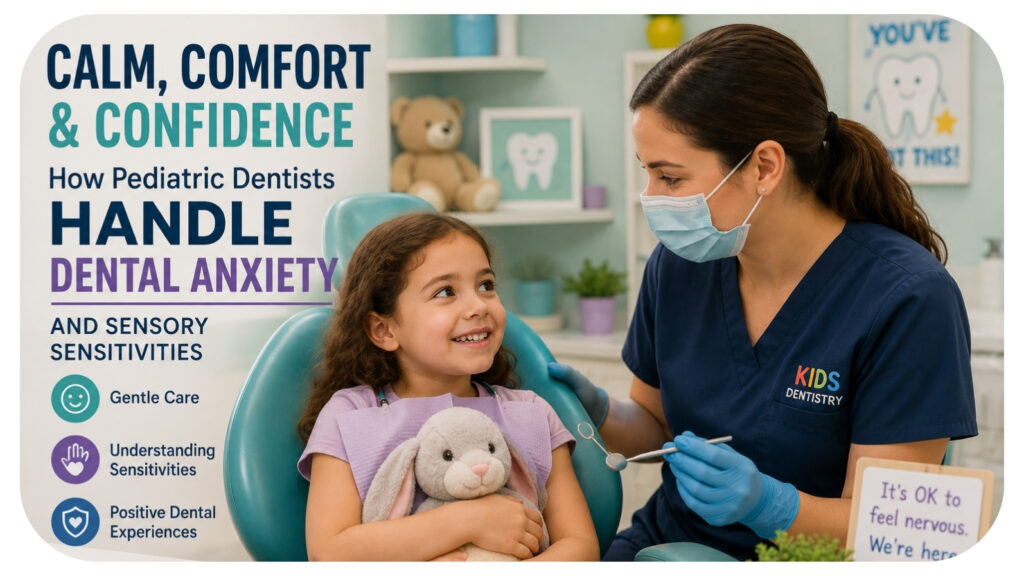
You might be feeling torn right now. You know your child needs dental care, yet the thought of actually getting them into the chair makes your stomach tighten. Maybe previous appointments with a pediatric dentist in Westchester ended in tears, meltdowns, or you walking out early, feeling like you failed your child. Or maybe you have not even booked a first visit because you already know how your child reacts to bright lights, strange sounds, or new people.
Because of this tension, you might wonder if there is such a thing as a dentist who truly understands anxious kids or children with sensory processing differences. There is. Pediatric dentists are trained to handle dental anxiety and sensory sensitivities with structure, patience, and respect. They use specific behavior guidance techniques, adapt the environment, and work with you so your child is not just “tolerating” care but slowly building trust.
In simple terms, here is the path forward. Pediatric dentists reduce fear by explaining things clearly, going at your child’s pace, and adjusting sounds, lights, and touch. They follow researched behavior guidance approaches and, when needed, collaborate with medical providers for children with complex needs. You are not asking for too much. You are asking for care that fits your child.
Why do some kids struggle so much with the dentist, and what makes it feel worse?
For many children, especially those with anxiety, autism, ADHD, or sensory processing challenges, a dental visit is like walking into a storm. Bright lights. Unfamiliar tools. The smell of materials. The sound of suction. A stranger’s hands in their mouth. Even a neurotypical adult can feel tense in that setting. For a child whose nervous system is already on high alert, it can feel overwhelming.
Think about a child who hates haircuts because of the buzzing clippers, or who melts down over clothing tags. Now imagine that same child lying back in a chair, with someone asking them to keep their mouth open, stay still, and “be brave.” The expectation alone can push them toward panic. When that happens, you might see kicking, crying, refusal, or complete shutdown. Then you go home feeling judged or discouraged.
What often makes it worse is when dental teams are rushed, use lots of medical language, or treat resistance as misbehavior instead of communication. A child who pushes a hand away is not being “difficult.” They are saying “this is too much for me” in the only way they can in that moment.
So where does that leave you when you still need your child’s teeth checked, cavities treated, or preventive care done on time?
How do pediatric dentists calm dental anxiety and sensory overload?
This is where specialized pediatric behavior guidance comes in. The American Academy of Pediatric Dentistry has detailed guidelines on behavior guidance for the pediatric dental patient. These are not vague tips. They are structured methods that pediatric dentists are trained to use and adapt to your child.
For anxious or sensory-sensitive kids, a pediatric dentist might:
- Use “tell-show-do.” They explain what will happen in simple words, show the mirror or toothbrush on a finger first, then gently do the procedure. This reduces the fear of the unknown.
- Adjust the environment. They may dim the light, offer sunglasses, use quieter tools when possible, or play calming music. Some offices have weighted blankets, fidget toys, or visual timers.
- Break visits into smaller steps. Instead of forcing a full cleaning at the first visit, they might focus only on a friendly exam, a ride in the chair, and counting teeth. The goal is trust first, full treatment later.
- Use clear, concrete language. They avoid vague phrases like “This won’t hurt,” and instead say what your child will feel. For example, “You will feel water and tickling on your tooth.”
- Offer choices where possible. “Do you want to sit in the chair by yourself or on Mom’s lap?” “Do you want bubblegum or strawberry toothpaste?” Control lowers anxiety.
For children with special health care needs, including autism or significant sensory differences, pediatric dentists often follow additional guidance, like the AAPD’s recommendations for managing dental patients with special health care needs. This may include:
- Longer or specially timed appointments, often first thing in the morning when the office is quieter.
- Visual schedules, social stories, or picture cards to show each step of the visit.
- Collaboration with your child’s physician or therapists to understand triggers and calming strategies.
- Use of protective stabilization or sedation only when safer options are not enough, and always with clear consent and discussion.
Handled well, pediatric dental anxiety management is not about forcing a child to “get over it.” It is about slowly rewiring their experience so each visit feels a little less scary and a little more predictable.
How do different approaches to pediatric dental care compare for anxious or sensory-sensitive kids?
You might be weighing your options. Do you keep seeing a general dentist who “means well,” or seek out a pediatric specialist, or even ask about sedation right away. Comparing the approaches can help you decide what fits your child and your values.
| Approach | What It Looks Like | Benefits | Limitations / Risks | Best For |
|---|---|---|---|---|
| General dentist without pediatric focus | Standard office, limited sensory adaptations, shorter visits | Convenient if already established, may be fine for mildly anxious kids | Less training in behavior guidance, higher chance of negative experiences or rushed care | Children with mild anxiety who already trust the dentist |
| Pediatric dentist using behavior guidance | Child-centered office, stepwise care, tell-show-do, sensory supports | Builds long-term trust, fewer traumatic experiences, better cooperation over time | May need multiple short visits to complete treatment, can require travel if few local options | Children with dental anxiety and sensory sensitivities who can gradually adjust |
| Pediatric dentist with sedation options | Same behavior guidance, with nitrous oxide or deeper sedation when required | Allows needed work when other methods are not enough, reduces immediate distress | Sedation has medical risks and cost, does not by itself teach coping skills | Children with severe anxiety, extensive treatment needs, or prior traumatic experiences |
| Hospital-based care for special health care needs | Care in a hospital or surgical setting, often under general anesthesia | Safe environment for complex medical needs, can complete significant treatment in one visit | Requires medical clearance, higher cost, limited availability | Children with significant medical or behavioral needs where office care is unsafe |
This comparison is not about “good” or “bad” choices. It is about fit. For many families, starting with a pediatric dentist for anxious children who uses behavior guidance, then adding sedation only if needed, creates the best balance between emotional safety and getting dental work done.
What can you do right now to make the next visit easier?
You cannot control everything about your child’s experience, but you have more influence than you might think. A few focused steps can shift the entire tone of care.
1. Share your child’s story in detail before the appointment
When you schedule, tell the office exactly what you see at home and in medical settings. Mention sensory triggers like bright light, loud sounds, certain tastes, or touch around the face. Share what helps calm your child, such as deep pressure, specific toys, or having a parent close.
Ask directly, “How do you usually handle dental anxiety and sensory sensitivities in kids?” The way the team answers will tell you a lot. A good pediatric dentist will welcome the information, not dismiss it.
2. Prepare your child with predictable, concrete tools
Children handle more when they know what is coming. You can:
- Use a simple social story with pictures showing the building, the chair, the light, the mirror, and a smiling child opening their mouth.
- Practice at home with a toothbrush or spoon. Take turns being the “dentist” and the “patient.” Keep it short and light.
- Decide on a signal your child can use to pause, like raising a hand. Tell the dentist about this signal at the start of the visit.
This is not about rehearsing perfect behavior. It is about giving your child a sense of control and familiarity.
3. Plan for support during and after the visit
On the day of the appointment, keep the schedule as calm as you can. Avoid back-to-back stressful activities. Bring comfort items such as headphones, a favorite toy, or a small weighted item if your child uses one.
During the visit, stay calm and speak slowly. If you are anxious, your child will feel it. You are allowed to ask for breaks, to remind the team of your child’s triggers, and to stop if it is clearly too much. Afterward, praise specific things your child did well, even if the visit was hard. “You opened your mouth for two counts.” “You sat in the chair and tried.” These small wins build resilience over time.
Where do you go from here?
You are not alone in this. Many parents of anxious or sensory-sensitive children feel exactly what you feel right now. Worried about cavities or pain, yet afraid of another meltdown or a dismissive provider. There is another way. A skilled pediatric dentist uses structure, patience, and compassion to make care possible, even for children who struggle the most with new experiences.
The next step is simple. Reach out to a pediatric dental office, share your child’s needs openly, and ask how they approach anxiety and sensory differences. You are not being difficult. You are advocating for care that respects who your child is. Over time, with the right support, the dentist’s office can shift from a place of dread to a place your child can handle, one small, supported step at a time.
Recommended: 5 Common Myths About Cosmetic Dentistry Debunked




Leave a Reply